
Yin and Yang in Saju: The Real Meaning
Yin yang saju is a practical framework within Korean Saju (four-pillars) that describes how opposing but complementary qualities appear in a birth chart. This is not mystical thinking — it’s a classificatory system rooted in East Asian calendrical and elemental theory used to organize tendencies, timing, and relationships across life areas. Read this as a model for observation and planning, not as a deterministic fate.

Basic concepts — what to look for
- Four pillars: year, month, day, hour. Each pillar has a Heavenly Stem and an Earthly Branch.
- Heavenly Stems (10) map directly to an element and a yin/yang polarity (e.g., Jia 甲 = Yang Wood, Yi 乙 = Yin Wood, Bing 丙 = Yang Fire, etc.).
- Earthly Branches (12) also carry yin/yang qualities and contain “hidden stems” (additional element influences).
- The Day Stem (the stem of the day pillar) is called the Day Master and represents the self; it is central when assessing balance.
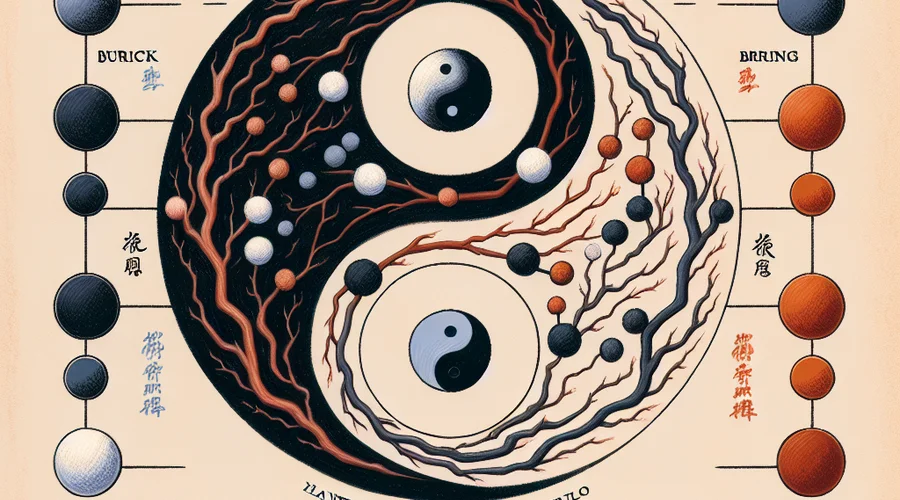
In practice, Yin and Yang in Saju is an inventory: how many yin vs. yang stems/branches are present, and how they relate to the Day Master and the Five Elements.
How to read yin/yang balance in a Saju chart — step-by-step
- Obtain a reliable Saju chart with year/month/day/hour stems and branches.
- Identify the yin/yang polarity of each Heavenly Stem. Mark each Earthly Branch as yin or yang as given in standard references.
- Count:
- Number of yang stems vs. yin stems among the Heavenly Stems.
- Optionally, include the Branch polarities or the hidden stems in the branches for a fuller count.
- Note the Day Master’s polarity and element. Compare the chart’s overall polarity to the Day Master.
- Interpret relational patterns: whether supporting elements are yin/yang, whether competing elements are yin/yang, and where strength or weakness concentrates.
Tips:
- Give more interpretive weight to Heavenly Stems than to hidden stems when starting out.
- Treat the Day Master as the primary reference: is the chart supportive, excessive, or lacking relative to that Day Master?
- Balance is not an exact numeric rule; context (month, season, and interactions among elements) matters.
Practical interpretations (non-mystical)
Yang-dominant charts
- Tend to correlate with outward-facing energy: action, initiative, responsiveness.
- May prefer visible roles, faster decision-making, and environments with stimulation.
- Practical considerations: structure work into clear action steps, manage stress by scheduling rest, and choose careers where visible results matter.
Yin-dominant charts
- Tend to correlate with inward-facing energy: reflection, detail work, adaptability.
- May prefer quieter settings, slower decision-making, and work that requires sustained focus.
- Practical considerations: build routines that protect quiet time, develop communication practices for networking, and choose roles with deep specialization.
Important clarifications:
- These are tendencies, not fate. Social context, education, personality, and choices shape outcomes.
- Health or career issues should be handled by relevant professionals; Saju offers an organizing lens, not a diagnosis.
Common, practical checks and actions
- Check timing: use season and month pillar to assess when yang or yin energies are stronger in the chart year by year.
- Occupational fit: match work rhythm to the chart’s polarity (e.g., yin charts may thrive in research, yang charts in front-line management).
- Daily rhythms: align sleep, work blocks, and social time with your chart tendencies to improve productivity and well-being.
- Social style: if your chart is strongly yin but your role requires yang, schedule regular blocks of “forceful” activity and deliberate transitions to recharge.
Simple balancing measures (practical, cultural, non-prescriptive)
Introduce missing elemental/yang or yin qualities through lifestyle choices:
- Activities: choose more outward activities (public speaking, team projects) for yang, more solitary deep work for yin.
- Environment: brighter, open spaces and active schedules support yang; quieter, warmer spaces support yin.
- Timing: plan important launches or public tasks when the calendar season or month supports yang; plan reflection or research in yin-favored months.
- Small, symbolic adjustments: colors, materials, and routines aligned with elements can make it easier to maintain consistent habits (not a magical “cure,” but practical nudges).
When a formal remedy is suggested (e.g., adding a missing element), interpret it as a behavioral or environmental change rather than a guaranteed fix.
Two short examples
Example A — Yang-leaning chart
- Day Master: Bing (Yang Fire).
- Heavenly Stems: 3 yang, 1 yin.
- Interpretation: natural orientation toward action and visibility. Practical move: schedule focused cool-down periods to avoid burnout; use structured checklists to channel yang energy.
Example B — Yin-leaning chart
- Day Master: Yi (Yin Wood).
- Heavenly Stems: 1 yang, 3 yin.
- Interpretation: reflective, detail-oriented tendencies. Practical move: add regular, time-boxed public-facing tasks to build visibility; systematize networking to protect quiet time.
Limits and cultural grounding
Saju, including yin yang saju analysis, is a traditional Korean system that evolved within historical calendrical and philosophical contexts. Use it respectfully and analytically. It offers a language for describing tendencies and timing, not deterministic outcomes. For medical, legal, or financial decisions, consult accredited professionals.
Next steps
If you want a structured way to apply yin yang saju to your own chart, start by generating your four-pillars chart and doing the stem/branch polarity count described above. For guided, culturally grounded explanations and tools, visit https://saju-boys.com.